The Bane of Safety: When Safety Professionals Become the Risk by Femi Da-silva

In a country where preventable accidents still claim lives, destroy livelihoods, and weaken institutions, one truth is becoming increasingly uncomfortable to say out loud, some of the very professionals entrusted with protecting lives have become the biggest threat to safety. This is not a sweeping condemnation of all safety practitioners, far from it.
Across Nigeria and Africa, there are ethical, passionate professionals who work tirelessly to improve standards. But there is a growing class of consultant-driven safety actors whose conduct is undermining the very purpose of safety.
And that is the real bane of safety today.


When Safety Becomes a Revenue Model
Safety, at its core, is meant to prevent harm, preserve life, and promote wellbeing. But in many government agencies and regulatory bodies, it has quietly been transformed into a revenue-generating machine.
Behind the scenes, some consultants few of them politically connected practitioners are:
- Advising policymakers to replace corrective guidance with punitive enforcement
- Recommending unrealistic fines and penalties for minor infractions
- Designing compliance systems that prioritize revenue over risk reduction
- Encouraging political appointees to see safety regulation as a cash cow
Instead of asking “How do we reduce risk?”, the conversation has shifted to “How do we generate income from non-compliance?”
That is not safety.
That is institutionalized extortion dressed in PPE.
The Dangerous Politics of Safety Consulting
A troubling pattern has emerged:
1. A consultant with a safety background gains influence or proximity to political power.
2. They are appointed (formally or informally) to advise on safety regulation.
3. They introduce “new frameworks” or “enforcement strategies.”
4. These strategies conveniently increase fines, penalties, licensing fees, and compliance charges.
5. The political leadership sees immediate revenue inflow and adopts the model.
But what gets lost in the process?
- Worker education
- Industry capacity building
- Preventive inspections
- Risk-based safety planning
In other words, the very foundations of safety management are sacrificed.
From Prevention to Punishment
True safety systems focus on:
- Identifying hazards
- Assessing risk
- Implementing controls
- Training people
- Monitoring performance
But in many agencies today, the approach has flipped:
Inspect → Catch → Penalize → Repeat
No meaningful engagement.
No corrective support.
No systemic improvement.
Just punishment.
And the result?
- Businesses go underground to avoid harassment
- Workers operate in more dangerous, unregulated environments
- Safety compliance becomes cosmetic, not functional
The Human Cost of Corrupt Safety Systems
When safety becomes transactional, people die.
Let’s be clear:
- Every inflated fine that replaces a corrective action
- Every compromised inspection
- Every politically-influenced enforcement decision
…creates a gap where risk thrives.
And in that gap, accidents happen.
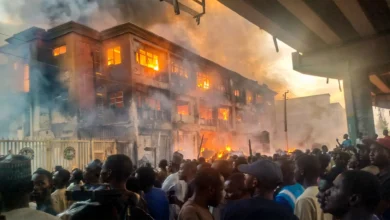
A factory fire spreads because enforcement focused on paperwork, not preparedness
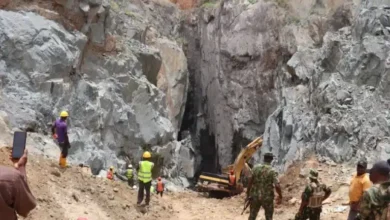
A building collapses or catches fire whereas building has been certified safe by this devilish practitioners…
These are not random incidents.
They are systemic failures fueled by compromised safety leadership.
The Silence of Ethical Professionals
Perhaps the most painful part of this crisis is the Silence (hence, why i choose to speak NOW)
Many ethical professionals see what is happening.
They know the difference between risk management and revenue extraction.
But they stay quiet because:
- They fear political retaliation
- They don’t want to lose contracts
- They are excluded from decision-making circles
- or they dont have the voice yet
And so, the system continues to rot from within.
*Reclaiming the Soul of Safety*
If we are to reverse this dangerous trend, three things must happen:
1. Separate Safety from Revenue:
Regulatory agencies must decouple fines from internally generated revenue targets.
Safety enforcement should never be used as a fiscal strategy.
2. Establish Independent Oversight:
There must be independent review mechanisms for safety regulations, enforcement actions, and penalty structures to prevent abuse.
3. Rebuild Ethical Leadership:
Professional bodies must stand up unity and speak up against or even sanction unethical practitioners and promote a code of conduct that prioritizes life over profit.
*A Call to Courage*
This is a call to:
* Ethical safety professionals
* Responsible policymakers
* Industry leaders
* Civil society
We must refuse to normalize a system where those entrusted with safety are incentivized to profit from danger.
Because at the end of the day:
Safety is not a business model.
It is a moral obligation.
The true bane of safety is not lack of knowledge, not lack of regulations, not even lack of funding.
The bane of safety is compromised integrity within the safety profession itself.
Until we confront this truth and act on it, our systems will remain unsafe, no matter how many policies we write or fines we collect.
By Femi Da-silva
CEO, AfriSAFE / HSENations
Advancing a safer Africa through advocacy, integrity, innovation, and impact.