LPG Tankers: Enforcing Safety Regulations and Managing Incident Excesses
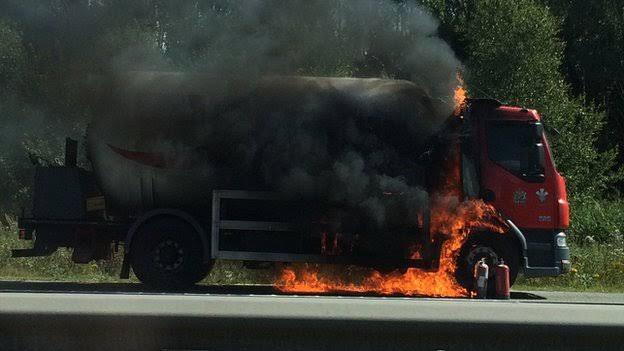
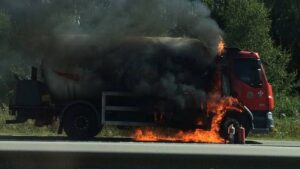
Over the years, tankers laden with the Liquefied Petroleum Gas (LPG) have intermittently brought havoc and unexpected loss of lives and properties in the country. The explosions occuring from these heavy duty vehicles have been attributed to poor handling of its high level combustible substance. Victory Bernard in this article writes on the safety dimensions, enforcement and strategies to curtail the excesses of such incidents.
On June 22, 2021, two persons lost their lives and 13 vehicles were razed, when a tanker loaded with 33,000 litres of Premium Motor Spirit (PMS), exploded on Lagos-Ibadan Expressway.
The incident reportedly occurred at the New Kara Market, Inbound Ibadan, with the tanker razed in the traffic affecting seven other trucks and two cars in the process.
The incident led to a gridlock on the road and halted construction activities around the area while vehicles heading towards Ibadan were diverted to Sagamu-Iperu-Ode/Remo-Saapade to relink the expressway.
Before the June 22nd incident, a more fatal one had happened earlier on June 17th which led to a rethinking among safety professionals on whether right safety structures were truly put in place.
A Gas tanker with 13.5 tons of LPG exploded at Opic Plaza close to Sheraton Hotel, Mobolaji Bank Anthony, Ikeja, which led to the destruction of lots of properties including 25 vehicles, the damage of Opic Plaza Structure; more than 10 injuries and about 5 deaths.
Investigations revealed that the LPG Gas was ignited by the exposed fire from the kitchen of the New Chinese restaurant which followed the trail of the LPG Gas resulting the combustion of the gas tanker outside the compound.
These are just among the few gas tanker incidents that has trailed the pages of the news for the last few months. There is a requisite need for urgent actions to be taken to manage the excesses of gas tankers that move on the roads.
While these incidents may not be totally obliterated, some steps could be taken to ensure that they are reduced to the minimal. The reduction will spiral to lesser loss of lives, properties and injuries like the one which occured at the Opic Gas Fire, in Ikeja.
Safety Experts believe that the challenges that surround the continuous explosion of gas tankers range from issues such as training, poor maintenance of truck facilities, poor regulations, and lack of awareness. They call for specific steps to be taken by the government to tackle these challenges.
The Executive Director, Rely Supply Limited, Fayo William, stated that incidents of LPG Tankers such as the one that occurred at Opic Plaza could have been avoided if strict measures were adhered to from “the loading, transportation, and distribution line.”
She called for the creation and implementation of Emergency Contingency plan noting that “safety needs to be taken seriously.”

While highlighting areas of avoidable lapses that could have lessened the fire’s effect, she made mention of poor awareness among citizens on the dangers of LPG; poor training and slow response rate from fire fighters.
“Not carrying out proper checks on a vehicle for leakages when loading the tanker or usage of a comprehensive checklist is a common issue in the transportation of LPG. LPG vapour can travel a long distance and once in contact with an ignition source, catches fire.”
In view of solutions she said, “The tankers must be roadworthy before using them in the transportation of gases. If proper training were in place, they could have recognised the signs earlier and taken steps to prevent such a catastrophe.”
“Citizens are not properly educated on the dangers of LPG and oftentimes when there are outbreaks, people rush to the scene of the incident trying to capture the event instead of taken safety steps. It is important that safety awareness is introduced at all levels from the schools, marketplace and religious settings, among others.”
“In an emergency, the swiftness of the rapid response could avert the dangers and severity of the incident. There is a need to have a strong line of defence when dealing with an emergency,” The NEBOSH Certified Safety Professional said.
The Chief Executive Officer (CEO), Surveillant Fire Ltd., Jumade Adejola, stated that the resuscitation of regulations by the government was the major solution to the problem stressing that there is a candid need for trucks that are ill-equipped to be removed from the road.
He said, “No matter what we are doing, the government has a lot of role to play. How do I mean? Regulations are still the order of the day. It is the only solution to these problems.”

“I’m very sure that somebody approved that truck to carry that fuel that day,” he said, reacting to the Opic Plaza Fire. “Somebody passed that thing out. A truck that developed faults must have been developing faults,” he said.
“If somebody who is in charge is doing what he suppose to do, I’m not sure those rickety vehicles should be on the road.”
“The person that sealed up that truck from the gas plant knew that the vehicle was not fit for that purpose. Why did that person allow the truck to move out?”
“Gas doesn’t just start leaking if the truck is good and this thing has been happening every time. This is not the first time. The only time we normally cry is when there is a major disaster like what happened,” the fire engineer noted.
Hence, as emphatically expressed by the safety professionals, it is pertinent for all actors involved in the facilitation of truck mobility to sit up and act in accordance with safety rules and regulations. These actors specially include owners of trucks, government authorities, safety professionals, and regulatory agencies.